





GHGA develops a secure environment for the genetic data of NAKO
- 16 Oct 2026
- Ulrike Träger
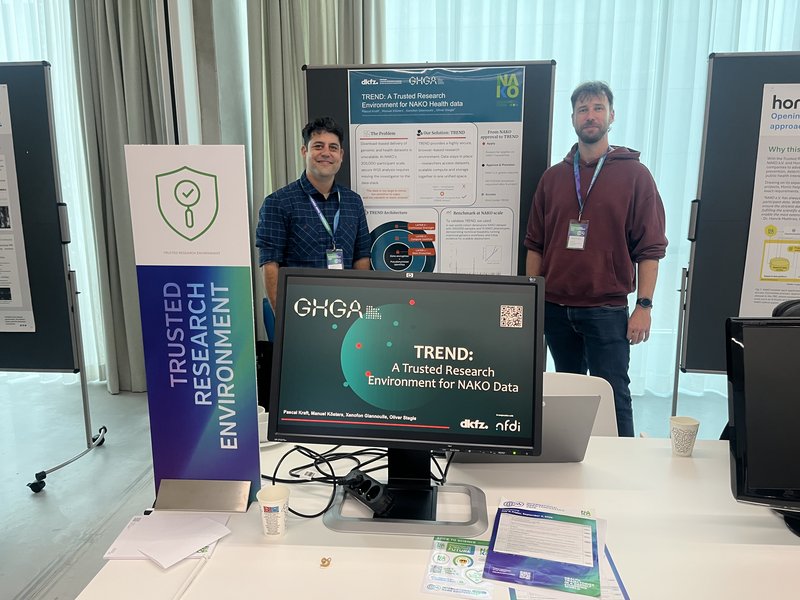
At the International NAKO Conference 2026 in Munich, held on 3 - 4 September 2026, the NAKO e.V presented its plans to make the next generation of data from Germany’s largest population-based health study available to researchers. From 2027, NAKO e.V. plans to provide access to its genotyping and multi-omics data through a secure processing environment (SPE) provided by DKFZ and NAKO e.V.. The SPE is being designed and developed by the GHGA Team at DKFZ under the leadership of Pascal Kraft .
For GHGA, this is the beginning of a collaboration to explore and develop the technical foundations for such an environment. The work is currently in an early stage, with GHGA associated researchers testing and validating approaches for secure analysis at the scale and sensitivity required by NAKO e.V..
Secure environment instead of download
NAKO plans were presented during the conference session Unlocking NAKO Data, where GHGA participant Leo Panreck, who is leading the research data management team at the NAKO e.V., outlined the study’s upcoming data releases. The next phase will include whole-cohort genotyping using the NAKO Prevention Array, deep molecular phenotyping across genetics, epigenetics, proteomics, metabolomics, serolomics, microbiomics and, for a subset of participants, viromics, as well as a second follow-up data freeze covering the first 50,000+ participants.
NAKO presented three routes for accessing these different types of data: dataset downloads, a SPE pilot primarily for industry and anonymous data, and the SPE developed by GHGA at the DKFZ for genotyping and multi-omics data. In both SPE projects, data would be analysed within a controlled environment rather than distributed as downloadable files.
GHGA presents early-stage work at the NAKO conference
GHGA used the conference to present the progress made so far. At the Knowledge Fair, Xenofon Giannoulis and Manuel Kösters demonstrated TREND (Trusted Research Environment for NAKO Health Data), an the early-stage SPE being developed in the context of the NAKO collaboration.
The work builds on an initial trial in which researchers from Helmholtz Munich tested the approach with phenotype data collected by Nako as well as data from an early genotyping pilot. To take the next step while protecting participant data, the team has benchmarked the environment using synthetic data designed to reflect the dimensions of the real cohort.
TREND includes several layers of protection: encrypted data and pseudonymised identities; job-based access to high-performance computing without direct file browsing; and tamper-evident logging combined with anomaly monitoring.
The prototype also illustrates a potential future workflow connecting NAKO’s data access process with an SPE:
Apply → Approve & Provision → Access
Researchers would apply for data access through the NAKO TransferHub. NAKO e.V. remains responsible for the data and for all decisions regarding data access. The roles are clearly defined: NAKO e.V. acts as the data controller, while DKFZ builds and operates the Secure Processing Environment (SPE). The GHGA team at DKFZ provides the technical platform and expertise. Since GHGA is a project and not a legal entity, it cannot take on legal responsibilities. In this context, DKFZ serves as the legal representative of GHGA.
The SPE provides researchers with a secure environment in which they can carry out their analyses without having to download sensitive genomic data.
Please note that at this stage, this workflow describes the approach currently being developed rather than a fully operational NAKO service.
Looking ahead
The conference also highlighted a broader shift in large-scale cohort research towards secure research environments, with initiatives such as UK Biobank and Our Future Health presenting platforms that bring researchers to sensitive data rather than distributing the data itself.
For GHGA, the work with NAKO is an important first step towards the next phase of GHGA’s infrastructure: a model in which data archived by GHGA can increasingly be made available to researchers through secure processing environments. Developing and testing these capabilities with a cohort of NAKO’s scale provides an opportunity to build experience with the technical, operational and data protection requirements such environments entail.
The NAKO work is still at an early stage, but it points towards a future in which sensitive genomic and molecular data can be accessed securely through SPEs while remaining protected.